The leg nobody asked for

By Max Buining, who builds extrudo · 5 min read
This is the part of the prompt that matters:
"...aluminium 40x40 profile side rails, a lagged drive drum and an idler drum with belt take-up, a PVC belt, legs with levelling feet at 800 conveying height and a geared motor on the drive end. I need it in three lengths, 1000, 1500 and 2000 mm between the drum axes, as configurations of one assembly..."
Legs with levelling feet. It doesn't say how many.
So you'd expect four legs in every length. That's what you'd get if you stretched the 1 m conveyor to 2 m. What came back is a 2 m version with a third leg set in the middle, and the log explains it the moment the leg set gets built:
"One leg set carries each end of the frame: two legs with feet, two cross members and six angle brackets, a subassembly so the 2 m variant can take a third."
Was it right?
Quick hand calculation. The leg sets sit 70 mm in from each drum axis, so the rails span 860 mm between legs on the 1 m version and 1,360 mm on the 1.5 m version. On the 2 m version that would be 1,860 mm.
The sag of a beam under an even load grows with the fourth power of its span. Going from 1,360 to 1,860 mm makes it about 3.5 times worse. With the third leg set the span is 930 mm, which is half the distance and about 16 times less sag, and very close to the 1 m version you started with.
That's a textbook estimate and not an analysis of this frame. But it's the right instinct, and it's the kind of thing you'd want a colleague to do without being told.
You can see the leg in the masses
Each configuration got rebuilt, weighed and exported. These are the numbers from the model:
- L1000: 1,150 mm long, 55.48 kg
- L1500: 1,650 mm long, 63.82 kg
- L2000: 2,150 mm long, 77.59 kg
Adding the first 500 mm costs 8.34 kg. Adding the second costs 13.77 kg. Those extra 5.4 kilograms are the third leg set.
One assembly, three lengths
The leg isn't the only thing it thought about. An assembly that works in three lengths has to be set up for it from the start, and this one is:
- All the frame parts come from one 40 x 40 profile with a configuration per cut length: rails of 900, 1,400 and 1,900 mm, legs of 690, cross members of 340.
- The parts at the tail end are mated to the end faces of the rails, so they follow along when the rails get longer. Switching length only means switching part configurations.
- The wear strip takes its length from the side guide by an equation, and the belt's tail arc follows the distance between the drums.
That's 18 part files, 34 components and 99 mates, in 652 steps and 16 minutes. Every length has its own part number, its own STEP file and its own image, which is what you'd send to a customer or a supplier.
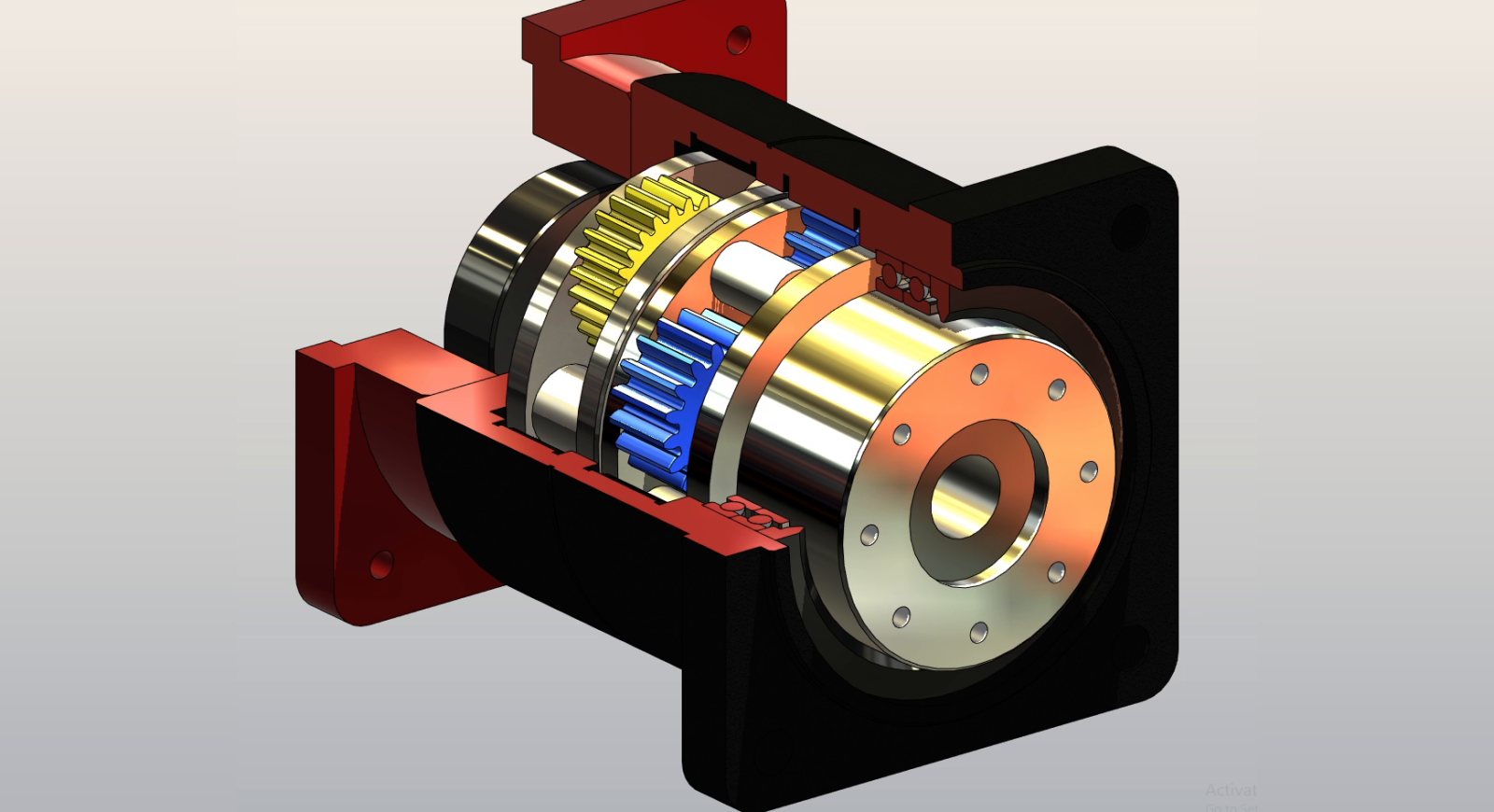
Then it ran the thing. Turning the drive drum turns the motor rotor 20 times as fast through the gearbox. A test carton rides 163.36 mm per drum turn, which is π times the belt's 52 mm pitch diameter. In 6 seconds at 64.27 rpm the carton travels 1,050.0 mm.
The bend lines a laser would have cut
The same thing happened on the control cabinet, in a way that would have saved someone real money. The prompt asked for a flat pattern of every sheet metal part as a DXF with bend lines. It got them, and then step 240 of the log says this:
"SOLIDWORKS writes the bend lines of one bend direction as solid lines, which a laser would cut. Mark every bend line dashed and count them per DXF."
Nobody had asked it to look at line styles in the export. Send the raw file to a laser and it cuts along those bends. The cabinet came out with 22 proper bend lines over 7 DXF files, plus the blank size of every part, and a door that was driven open through 110 degrees with a clash check at every 10 degrees.
Why this matters more than the jet engines
Those machines get the views, but most of the people on our waitlist build machines. For them, the interesting question is whether the AI thinks about the job or only about the shape. These two builds are our best answer so far.
They were test builds: an AI agent on the same SOLIDWORKS tools as extrudo, working from a spec it drew up itself from the prompt. You'll still look over what it decided, the way you would with any colleague.
See both on the use cases page.
FAQ
Can an AI build length variants of an assembly in SOLIDWORKS?
Yes, as configurations of one assembly. In this conveyor each length switches the rails, slider bed, side guides and belt to their own configuration and has its own part number, mass and STEP file.
When does a conveyor frame need a middle support?
It depends on the profile and the load. Sag under an even load grows with the fourth power of the span, so doubling the span makes it 16 times worse. That's why long frames usually get extra legs.
Why does a SOLIDWORKS DXF flat pattern need checking before laser cutting?
Bend lines have to be on a line style or layer that your laser treats as marking, not cutting. In our cabinet build, one bend direction came out as solid lines and had to be changed to dashed. Check how your own export and your shop's setup handle it.