How a swashplate works: steering a blade that's spinning

By Max Buining, who builds extrudo · 6 min read
Our reel of this rotor head passed 380,000 views in its first day and was shared almost 6,000 times. My guess is that it's hypnotic for a simple reason: you can see the blades twist, and you can't quite see why.
So here's the why. It's one of the best pieces of mechanical design I know.
The problem
A pilot's controls are bolted to the airframe. The blades are spinning, on this kind of rotor 258 times a minute. Each blade has to change its angle on command, by a different amount at every point of its turn.
So a command has to get from something standing still into something spinning more than four times a second. You can't run a cable across that gap, because it would wrap around the mast.
Two plates and a bearing
The answer is a swashplate, and it's almost rude how simple the idea is.
From the bottom up:
- Three servos push on the stationary plate. Three points define a plane, so three servos can put the plate at any height and any tilt.
- The stationary plate sits on a uniball, a sphere that slides along a guide tube around the mast. It can tilt and rise, and a pair of scissor links stops it from turning.
- The rotating star rides on top of it on a bearing. It copies every tilt of the plate below, and a second pair of scissors makes it turn with the hub.
- Four pitch links run from the arms of the star up to a horn on each blade. Push a link up and its blade twists.
That bearing is the whole trick. Below it nothing turns, above it everything does, and the tilt passes straight through.
Two ways to move the plate
Collective. All three servos push the same way, so the whole plate rises. Every blade gets more pitch at the same moment, the rotor makes more lift and the helicopter climbs.
Cyclic. The servos tilt the plate. As a blade comes round to the high side its pitch link pushes up, and on the low side it pulls down. So each blade goes through more and less pitch once per turn, lift becomes uneven around the disc, the rotor tips and the helicopter goes that way.
One more thing that surprises most people: a spinning rotor reacts about a quarter of a turn late. To lift the rotor at the back, the highest pitch has to arrive out at the side. The control system is laid out with that offset built in.
What the model does
Four motors drive the whole thing: one on the mast and one on each servo. In a 5 second motion study the mast makes one turn, and SOLIDWORKS measures this:
- The stationary plate tilts up to 5.35 degrees.
- The uniball rides 41.4 mm up the guide tube.
- The servo pistons stroke 33.1, 53.4 and 88.7 mm.
- Blade pitch at 75% of the radius runs from -1.0 to 23.0 degrees, once per turn.
My favourite number is this one: while the mast turns 360 degrees, the rotating star turns 360.19. It tilts as it goes round, and that adds a little. Nobody typed that in. It falls out of the mates.
How it got built
An AI agent did this on the same SOLIDWORKS tools extrudo runs on. Public sources gave it the rotor radius, the chord, the twist, the tip sweep and the blade count. It worked out everything else: every other dimension, the proportions of the hub and swashplate, and the layout of the servos and scissors.
Before anything went into SOLIDWORKS, it solved the linkage in a script and checked that the design could actually move:
- The angle between horn and pitch link stays between 75.8 and 100.9 degrees, so the linkage can't lock up.
- The rod ends never misalign by more than 13.4 degrees.
- The nearest moving parts stay 9 mm apart.
Then the build: a titanium hub star with elastomeric bearings, four cuffs with pitch horns, and four 8.2 m blades lofted through twisted airfoil sections to a 20 degree swept tip, plus four lead-lag dampers and the vibration absorber on top. The final run took 467 steps and 14 minutes 35 seconds. The stroke and travel numbers SOLIDWORKS measured match the script to 0.1 mm, and the interference check at the start pose came back with zero.
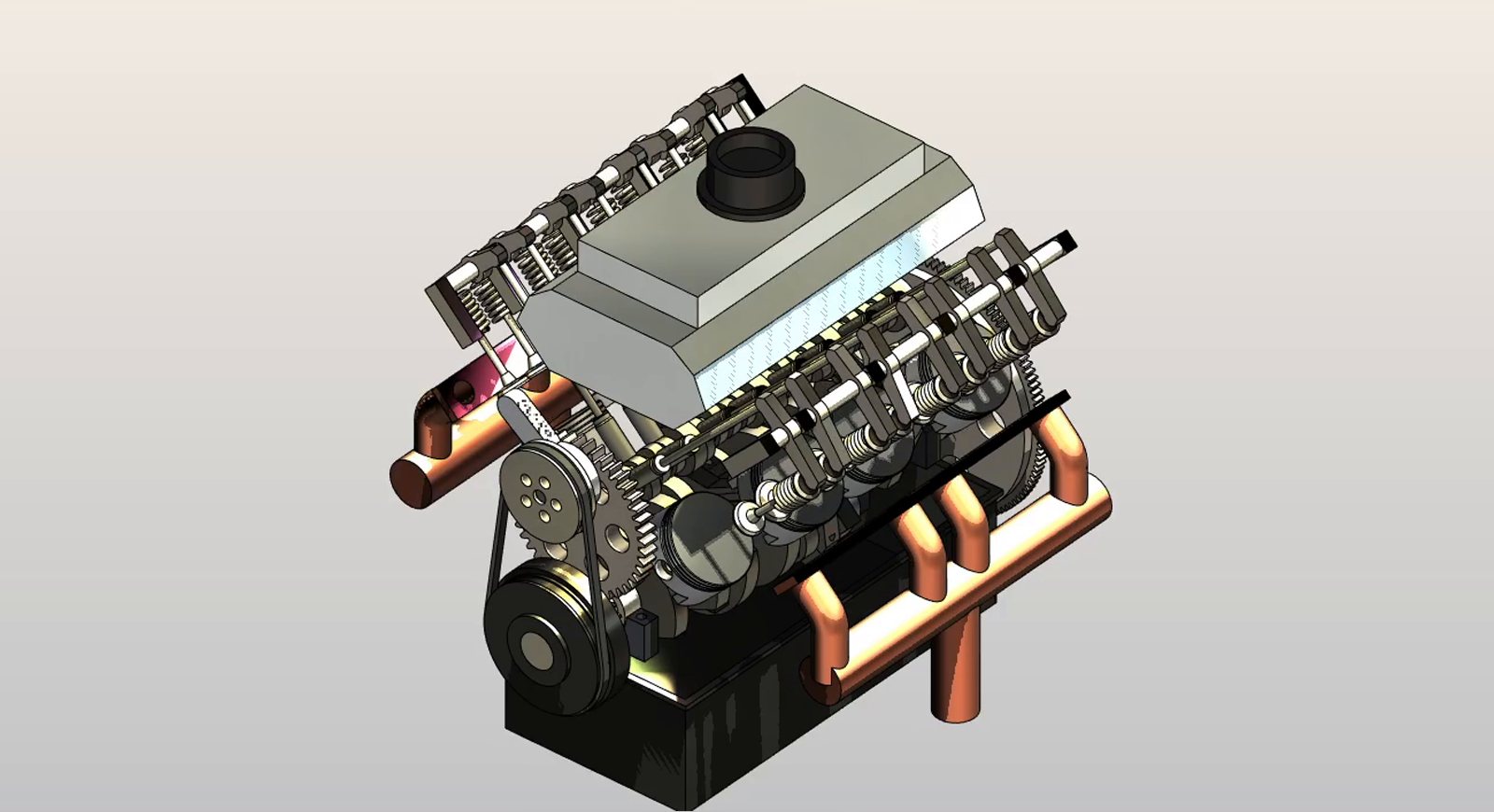
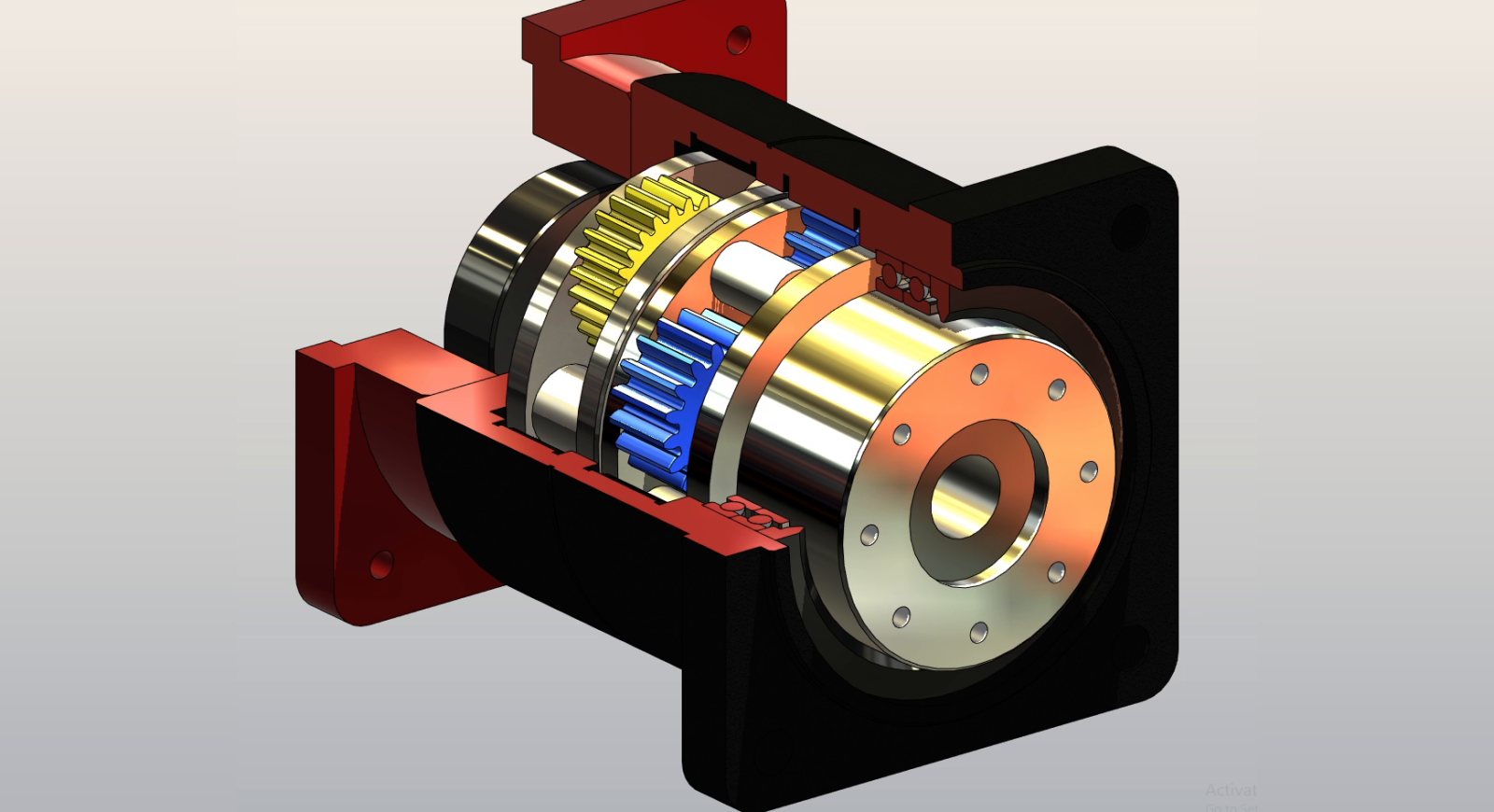
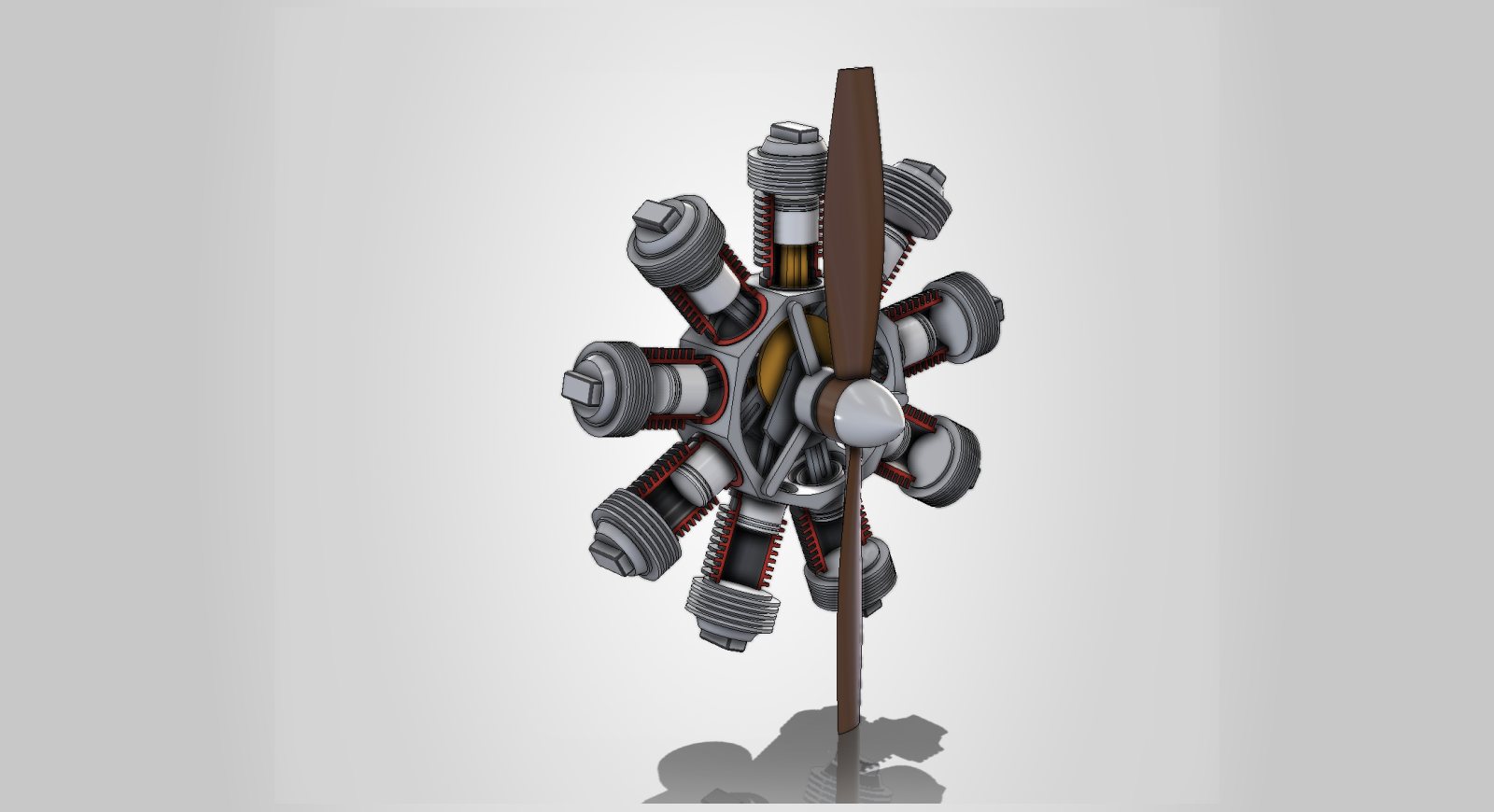
There's more of this kind of thing on the machines page: a V8, a planetary gearhead, a Mars rover.
This is a fan model, built from public photos and figures to show what extrudo can model. The blades are rigid in flap and lag, and there are no aerodynamic forces, so it shows the mechanism and not the flight. Not affiliated with or endorsed by Sikorsky or Lockheed Martin. Not for download or sale.
FAQ
What does a swashplate do on a helicopter?
It carries the pilot's commands from the fixed airframe to the spinning blades. Servos move a stationary plate, a rotating plate above it follows on a bearing, and pitch links turn that movement into a change of blade angle.
What is the difference between cyclic and collective?
Collective raises the whole swashplate, so all blades change pitch together and the rotor makes more or less lift. Cyclic tilts it, so each blade changes pitch once per turn, which tips the rotor in the direction you want to go.
Why does a swashplate have three servos?
Three points define a plane. With three servos you can set any combination of height and tilt, which covers both collective and cyclic.
What are the main types of helicopter rotor heads?
Three. Fully articulated: each blade can flap, lead-lag and change pitch on its own hinges or elastomeric bearings. Semi-rigid or teetering: two blades rock together like a seesaw. Rigid or hingeless: flexible parts of the hub do the work of the hinges. The real rotor head behind this fan model is fully articulated, and all three normally change blade pitch through a swashplate.
Does the V-22 Osprey have a swashplate?
Yes, two. Each of its proprotors has its own swashplate that sets collective and cyclic pitch, the same job it does on a helicopter.
What is a swashplate in a hydraulic pump?
In an axial piston pump the swashplate is a tilted plate the pistons ride on. As the cylinder block turns, the tilt pushes each piston in and out, and changing the angle changes how much oil every turn pumps. Same name, same idea: a tilted plate that turns rotation into a stroke.
Can you model a swashplate in SOLIDWORKS?
Yes. With mates for the closed loops and a motion study driving the mast and servos, SOLIDWORKS solves the kinematics: plate tilt, pitch link travel and blade pitch. It doesn't calculate the aerodynamics.